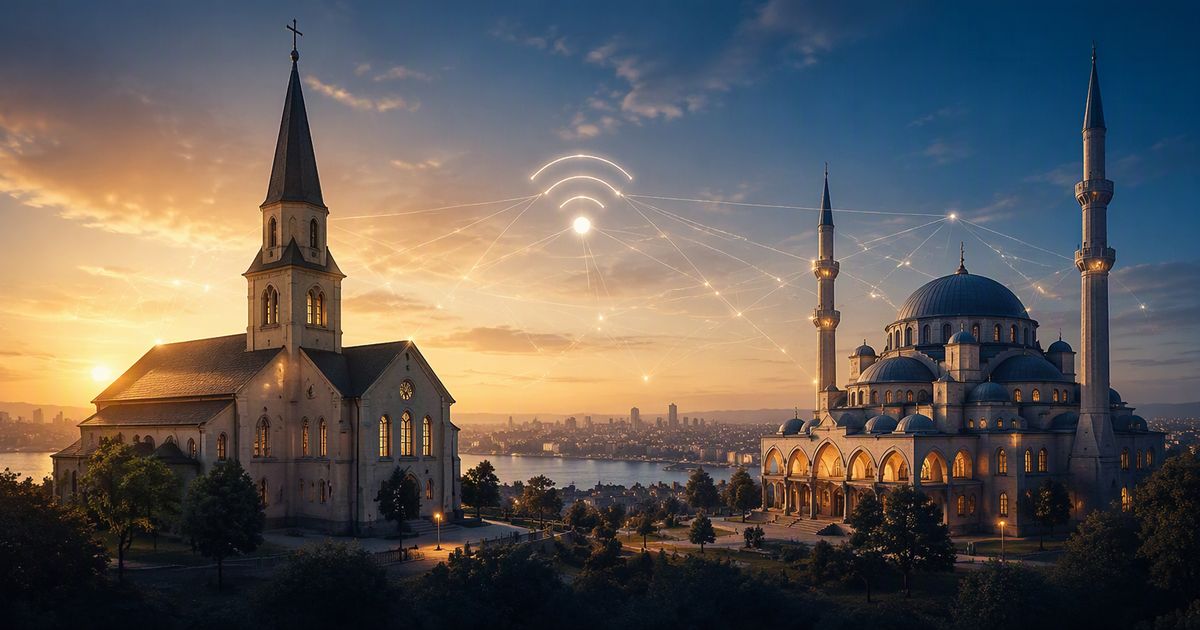
Why Every Church and Mosque Now Needs a Digital Home
Stand at the entrance of almost any church or mosque in Kenya this weekend and watch what happens before the service begins. A decade ago, the hall would have filled with conversation. Today, a large share of that attention is pointed downwards — at phones. Members are checking the service times they forgot, sharing the livestream link with a relative abroad, sending their offering through M-Pesa, looking up last week's sermon, messaging the welfare committee, photographing the announcement slide for a friend who is not there. This is not a loss of faith or attention; it is the congregation doing congregational life on the devices they carry everywhere. The question for every church and mosque leadership is no longer whether to have a digital presence. It is whether that presence will be an owned, organised home — or a scattered patch of rented land.
The Congregation Moved to the Phone
The evidence is in every pew and every prayer mat row. The midweek member who wants to confirm Friday prayers' time does not drive past the mosque; they search. The youth who missed Sunday service does not wait for a cassette or a CD; they look for the recording. The diaspora family that still considers this congregation home does not send a letter; they look for a way to give and to watch. Each of these moments is small, but they compound into the institution's public face — and today that face is whatever Google, WhatsApp and social platforms happen to show. For most institutions, what they show is fragmented: an old Facebook page, a WhatsApp group with three hundred unread messages, a YouTube channel with no schedule, a notice board photo that expired last month.
None of these tools is wrong. Each is genuinely useful. The problem is that none of them belongs to the institution, none presents it completely, and none was designed to serve a visitor who has never set foot in the building — the new resident searching for a mosque in the neighbourhood, the couple looking for a church after moving to a new estate, the donor abroad deciding whether an institution looks trustworthy enough to support.
What a Digital Home Actually Is
A digital home is one owned website that gathers everything the institution already does into one address that leadership controls. At its core it holds the basics every visitor needs: service and prayer times, the location with directions, contact details for the office and the welfare team, and a clear welcome for newcomers. Around that core it organises the institution's real life: sermons and khutbahs — recorded or written — organised so a member can follow a series rather than scroll an endless feed; events and programmes, from halaqas and Bible study to weddings and fundraisers, each with details and a way to respond; announcements that stay findable after the day they were made; ministries and departments, each with its own page and contact; and giving — tithe, zakat, sadaqah, building fund — with M-Pesa integration that lets a member or a well-wisher contribute in the moment the heart moves them.
Notice what is absent from that description: anything that replaces the physical congregation. A digital home is not a streaming ministry with a building attached; it is the building's front door, notice board, library and offering plate, extended to the phone. Institutions that treat it as a replacement lose something real. Institutions that treat it as an extension gain reach without giving anything up.
Social Media Is Rented Land
Every institution we speak to already has a Facebook page or an Instagram account, and the question is always the same: is that not enough? It is not, for three structural reasons. First, the rules belong to the platform: a change in the algorithm can quietly stop your posts from reaching your own members, and accounts can be restricted, hacked or removed with no appeal that a court would recognise. Second, platforms are feeds, not homes — yesterday's announcement is buried by this morning's posts, and a newcomer landing on your page meets a stream, not a welcome. Third, platforms fragment your presence: the sermons live on YouTube, the photos on Instagram, the discussions on WhatsApp, and nowhere does it add up to one picture of who you are.
A website you own answers to your leadership, not a platform's engagement metrics. It is findable by search — which is how newcomers actually look for a congregation — and it keeps its content organised for years. The right posture is simple: social platforms are the streets where you meet people; the website is the building where you welcome them. You need both, but only one of them is yours.
The Giving Question
For many institutions, this is the decisive section. Giving is the lifeblood of congregational life — tithes and offerings, zakat and sadaqah, building funds and welfare appeals — and for years it happened in one physical moment: the plate, the box, the fund-raiser after Jummah or after Sunday service. But members' money has already moved to the phone, and so has a meaningful share of their generosity. The diaspora son in London who would gladly support the mosque's expansion, the daughter in Nairobi working late who still wants to tithe, the well-wisher moved by a welfare appeal — none of them can be reached by a physical plate on a physical day.
Online giving through a website changes the economics without changing the theology. With M-Pesa integration, a member can give in under a minute from anywhere, at any hour; the welfare team receives records automatically, which makes accountability and reporting dramatically easier; and appeals can reach members and well-wishers the moment the need is confirmed, not the following weekend. Institutions that adopt it consistently report the same surprise: online giving does not replace the plate — it adds a channel that was always there, uncollected. The offering that faith prompts at 2 AM on a Tuesday finally has somewhere to go.
Enjoying this? See how Card Payment Integration does it for your business — proven, managed, live.
Explore Card Payment IntegrationReaching the Next Generation — and the Diaspora
Two groups decide an institution's future, and both live online. The youth in the congregation will not search a notice board or wait for an announcement; if the institution is not where they look, it slowly stops existing for them, and the evidence of drift is familiar to every leadership. The diaspora is the mirror image: Kenyans abroad who still call this congregation home, who want to watch services, follow programmes and support the institution financially — but who can only do so if there is a single, stable, professional place to do it from. A digital home serves both without favouring either: sermons on demand for the one, livestreams and remote giving for the other, and for the visitor who has never attended, a front door that says clearly — here is who we are, here is when we meet, you are welcome.
What It Costs and How Long It Takes
Institutions consistently overestimate both numbers because they are quoted agency prices built for businesses. A congregational website — service times, sermons, events, ministries, online giving, mobile-first — is a well-understood project with fixed scope, and it can be built properly in days, not months, at a cost that is small against a single fundraiser's proceeds. The ongoing costs are modest too: a domain name, hosting, and occasional content updates, which a volunteer with thirty minutes a week can handle once the structure is in place. The right comparison is not what a website costs; it is what the institution already spends printing bulletins, duplicating announcements across three platforms and losing gifts that had no channel to arrive through.
There is also a stewardship argument that resonates with every finance committee we have sat before: the institution maintains a physical building at real cost, because the ministry requires a place to gather. The digital building now carries an equivalent share of the ministry's reach, and it costs a fraction of the physical one. Neglecting it is not thrift; it is leaving part of the mission unfunded.
Frequently Asked Questions
We already have a WhatsApp group and a Facebook page. Why add a website?
Because those tools serve members who are already inside, while a website serves everyone else — newcomers searching for a congregation, the diaspora looking for one stable address, and members who need information that does not drown in chat. Think of the website as the institution's front door and library; social platforms are its noticeboard and courtyard. One does not replace the other, but only the website is owned, searchable and complete.
Is online giving appropriate for a church or mosque?
The underlying practice is unchanged — giving remains voluntary, recorded and accountable, and leadership sets the frameworks their tradition requires. What changes is the channel: members and well-wishers can give by M-Pesa in the moment they are moved, from anywhere, with automatic records that make reporting to the finance committee far easier. Institutions consistently find that online giving adds a new channel rather than replacing the physical one.
Who updates the website — do we need to hire staff?
No. A well-built congregational site is designed for volunteers: adding a sermon, posting an announcement or updating service times takes minutes, and training one or two youth volunteers usually covers it completely. We hand over with documentation and a short training session, and support arrangements exist for institutions that prefer everything handled for them.
What if our leadership is not tech-savvy?
That describes most of the institutions we serve, and it has never been the obstacle it seems. Leadership does not need to operate the site — it needs to approve its content and appoint one or two people to maintain it. The decision required is the same as approving a new notice board: decide it should exist, put it in responsible hands, and let it serve the congregation.
The Bottom Line
The congregation did not abandon the sanctuary; it simply carried the sanctuary's life into its pocket. Institutions that meet them there — with one owned, organised, welcoming digital home — grow in reach, in giving and in the next generation's loyalty, while those that stay fragmented across rented platforms slowly become invisible to the very people they exist to serve. The barrier is no longer cost or complexity; it is only the decision. If your church or mosque is ready to open its digital front door, we will build it the way we build everything — complete, mobile-first, with M-Pesa giving integrated — and you will see it working live before you pay a single shilling. That is not a sales line. It is simply how we work.
Ready to put this into action?
Everything in this article is something we build, deploy and manage for businesses like yours. Explore Card Payment Integration — or tell us your goal on WhatsApp and we will recommend the right product.
#EveryChurchMosque #KenyaTech #IndustryInsights #DigitalKenya #NexaFlowDigital #KenyaBusiness